Fitting Guide
Jewellery Size Guide
The right fit makes all the difference. Use these charts and measurement methods to find your perfect size in rings, bangles, chains, bracelets, and earrings - or WhatsApp us a photo and we will match it for you.
Ring Sizes
Indian Ring Size Chart (1-30)
Indian ring sizes are numbered 1 to 30, based on the inner circumference of the ring. This is the standard used by most jewellers in India, including Gondilal Saraf.
| Indian | Diameter (mm) | Circumference (mm) | US | UK | EU |
|---|---|---|---|---|---|
| 1 | 12.04 | 37.8 | 1 | B | 38 |
| 2 | 12.45 | 39.1 | 1.5 | C | 39 |
| 3 | 12.85 | 40.4 | 2 | D | 40 |
| 4 | 13.26 | 41.7 | 2.5 | E | 42 |
| 5 | 13.67 | 42.9 | 3 | F | 43 |
| 6 | 14.07 | 44.2 | 3.5 | G | 44 |
| 7 | 14.48 | 45.5 | 4 | H | 46 |
| 8 | 14.88 | 46.8 | 4.5 | I | 47 |
| 9 | 15.29 | 48.0 | 5 | J | 48 |
| 10 | 15.70 | 49.3 | 5.5 | K | 49 |
| 11 | 16.10 | 50.6 | 6 | L | 51 |
| 12 | 16.51 | 51.9 | 6.5 | M | 52 |
| 13 | 16.92 | 53.1 | 7 | N | 53 |
| 14 | 17.32 | 54.4 | 7.5 | O | 55 |
| 15 | 17.73 | 55.7 | 8 | P | 56 |
| 16 | 18.14 | 57.0 | 8.5 | Q | 57 |
| 17 | 18.54 | 58.3 | 9 | R | 58 |
| 18 | 18.95 | 59.5 | 9.5 | S | 60 |
| 19 | 19.35 | 60.8 | 10 | T | 61 |
| 20 | 19.76 | 62.1 | 10.5 | U | 62 |
| 21 | 20.17 | 63.4 | 11 | V | 63 |
| 22 | 20.57 | 64.6 | 11.5 | W | 65 |
| 23 | 20.98 | 65.9 | 12 | X | 66 |
| 24 | 21.39 | 67.2 | 12.5 | Y | 67 |
| 25 | 21.79 | 68.5 | 13 | Z | 69 |
| 26 | 22.20 | 69.7 | 13.5 | Z+1 | 70 |
| 27 | 22.61 | 71.0 | 14 | Z+2 | 71 |
| 28 | 23.01 | 72.3 | 14.5 | Z+3 | 72 |
| 29 | 23.42 | 73.6 | 15 | Z+4 | 74 |
| 30 | 23.83 | 74.8 | 15.5 | Z+5 | 75 |
How to Measure Your Ring Size at Home
String Method
Cut a piece of string or thread. Wrap it snugly around the base of your finger - not too tight, not too loose. Mark where the string overlaps. Measure the length in mm with a ruler. This is your circumference - find it in the chart above.
Paper Strip Method
Cut a thin strip of paper (about 10 mm wide). Wrap it around your finger with the printed/marked side facing out. Where the paper overlaps, mark a line with a pen. Unwrap and measure the distance from the edge to the mark in mm.
Existing Ring Method
Place a ring that fits well on a ruler. Measure the inner diameter (the widest point across the inside) in mm. Match it to the diameter column in the chart. This is the most accurate home method.
Measure at the end of the day when your fingers are slightly larger. If the ring needs to pass over a large knuckle, measure both the knuckle and the base of the finger, then choose a size in between.
Bangle Sizes
Indian bangle sizes use a traditional numbering system (2-2, 2-4, etc.) based on the inner diameter. The most common size for Indian women is 2-6.
| Indian Size | Diameter (mm) | Circumference (mm) | Fits |
|---|---|---|---|
| 2-2 | 54.0 | 169.6 | Very petite wrist |
| 2-4 | 57.2 | 179.6 | Small / teen wrist |
| 2-6 | 60.3 | 189.4 | Average Indian women |
| 2-8 | 63.5 | 199.5 | Medium-large wrist |
| 2-10 | 66.7 | 209.4 | Large wrist |
| 2-12 | 69.9 | 219.6 | Extra large wrist |
How to Measure Your Bangle Size
Existing Bangle Method
Place a bangle that fits comfortably on a flat surface. Measure the inner diameter (straight across the inside) in mm using a ruler. Match it to the chart above. This is the easiest and most reliable method.
Ruler Method
Close your fingers together as if sliding on a bangle (thumb touching pinky). Using a ruler, measure the widest point across your hand in mm. This gives you the minimum diameter needed for the bangle to pass over your hand.
Measuring Tape Method
Wrap a flexible measuring tape around the widest part of your hand (knuckles with thumb folded in). Divide the measurement by 3.14 to get the diameter. Choose the nearest bangle size from the chart.
Your dominant hand is usually slightly larger. If buying a pair of bangles, measure both wrists and go with the larger measurement. Oval / kada bangles may fit differently than round bangles.
Chain & Necklace Lengths
Chain length determines where a necklace sits on your body. The most popular everyday length is 18 inches (princess). Bridal and traditional sets typically range from 20 to 32 inches.
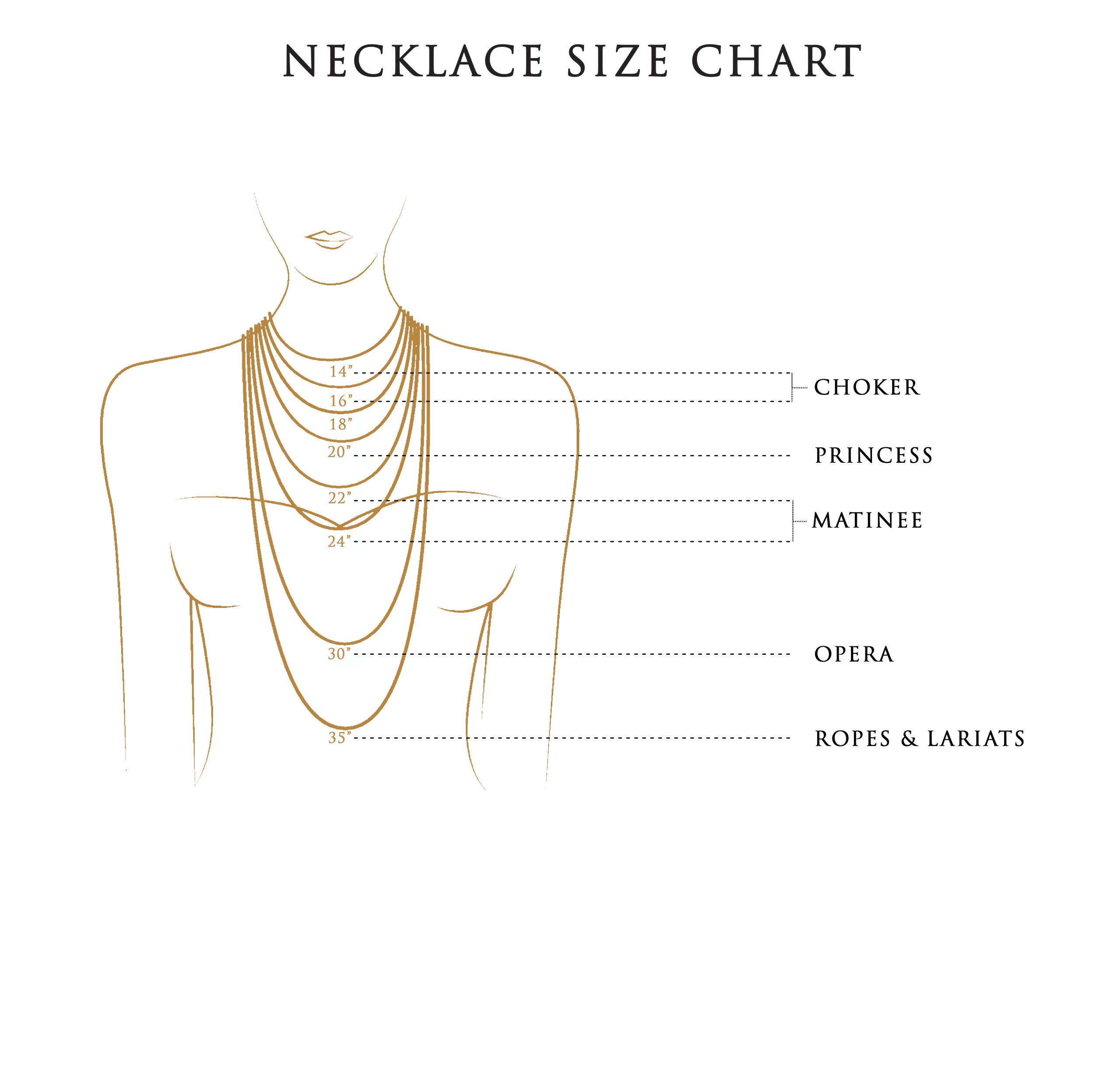
| Length | CM | Name | Where It Sits | Best For |
|---|---|---|---|---|
| 14" | 36 | Choker | Tight around the neck | Traditional choker sets, hasli |
| 16" | 41 | Collar | Base of the neck | Mangalsutra, light pendants |
| 18" | 46 | Princess | Just below the collarbone | Most popular length for pendants & chains |
| 20" | 51 | Matinee (short) | Above the bust line | Rani haar (first layer), statement pendants |
| 24" | 61 | Matinee (long) | At the bust line | Layering, long pendants, sautoir style |
| 28" | 71 | Opera (short) | Below the bust | Bridal rani haar, temple jewellery |
| 32" | 81 | Opera | At the navel / waist | Bridal multi-strand sets |
| 36" | 91 | Rope | Well below the waist | Double-wrap, knotted styles, waist chains |
Popular Indian Necklace Types & Typical Lengths
Mangalsutra (16-18")
Usually worn close to the neck, under clothing
Thali / Thaali (16-20")
South Indian marriage chain, moderate length
Temple Necklace (18-22")
Traditional temple motifs, princess to matinee
Rani Haar (24-32")
Long multi-layered, bridal statement piece
Hasli / Hansuli (14-16")
Rigid collar-style, sits tight around the neck
Pendant Chain (16-20")
Everyday chain with a single pendant
To visualise a necklace length at home, hold a string of the same length around your neck in front of a mirror. Add 2 inches if you want a slightly looser drape than what the chart shows.
Bracelet Sizes
How to Measure Your Wrist
Using a Measuring Tape
Wrap a soft measuring tape around your wrist, just above the wrist bone (where you would normally wear a bracelet). Keep it snug but not tight. Note the measurement in centimeters.
Using Paper / String
If you do not have a measuring tape, wrap a strip of paper or string around your wrist. Mark where it meets, then measure the length with a ruler. Add 1.5-2 cm for a comfortable bracelet fit.
Standard Bracelet Sizes
| Size | Wrist Measurement | Bracelet Length |
|---|---|---|
| XS | 13.5 - 14.5 cm | 15.5 - 16.5 cm |
| S | 14.5 - 15.5 cm | 16.5 - 17.5 cm |
| M | 15.5 - 16.5 cm | 17.5 - 18.5 cm |
| L | 16.5 - 17.5 cm | 18.5 - 19.5 cm |
| XL | 17.5 - 19.0 cm | 19.5 - 21.0 cm |
Most women's bracelet sizes fall between S and M (15-17 cm wrist). If you like a snug fit, add only 1 cm to your wrist measurement. For a looser fit, add 2-2.5 cm.
Earring Types & Weights
Earring weight directly affects comfort. Heavier earrings can stretch earlobes over time, so choose the right weight for how long you plan to wear them.
| Type | Typical Weight | Comfort Level | Best Occasion |
|---|---|---|---|
| Stud | 1 - 4 g | All-day comfortable | Daily wear, office, gym |
| Small Hoop | 3 - 6 g | Comfortable for most of the day | Daily & casual outings |
| Jhumka (small) | 6 - 12 g | Comfortable for a few hours | Puja, festivals, casual functions |
| Jhumka (large) | 12 - 20 g | Best for shorter durations | Weddings, engagements, sangeet |
| Chandelier / Chaand Bali | 15 - 30 g | Wear for the event, remove after | Bridal, reception, special occasions |
| Ear Chain (Kan Chain) | 8 - 15 g | Chain distributes weight to hair | Bridal, traditional functions |
If you love heavy jhumkas but worry about comfort, ask for hollow / lightweight construction - gold pieces can be made hollow to reduce weight by 40-60% without changing the look. Gondilal Saraf specialises in lightweight traditional designs.
Sizing Tips
When in doubt, go one size up
It is easier to make a slightly loose ring or bangle snugger (with a ring guard or adjustable clasp) than to stretch a tight one. A size up also accounts for seasonal swelling.
Measure at the end of the day
Fingers and wrists are slightly larger in the evening due to normal activity, warmth, and fluid retention. A ring that fits perfectly in the morning may feel tight by dinner.
Temperature matters
Cold weather shrinks fingers; hot weather expands them. If you are measuring in winter, your summer size may be half a size larger. Consider your climate when choosing.
Wide bands need a larger size
A wide ring (8mm+) will feel tighter than a thin ring of the same size because more skin is covered. Go half to one size up for wide bands.
Measure multiple times
Measure your finger or wrist at least 3 times on different days to account for natural fluctuations. Take the average.
WhatsApp us a photo
Still unsure? Send us a photo of your existing piece on WhatsApp at +91 93358 78550 and we will match the size for you. You can also visit our shop at Gular Naka, Banda for a free sizing.
Frequently Asked Questions
How do I find my ring size at home?+
Wrap a thin strip of paper or string snugly around your finger. Mark where it overlaps, then measure the length in millimeters. This is your finger circumference. Match it to the Indian ring size chart above. For best accuracy, measure at the end of the day when fingers are slightly larger.
What is the most common bangle size in India?+
The most common bangle size for Indian women is 2-6 (inner diameter approximately 60.3 mm). It fits an average adult female wrist. If you are between sizes, go one size up for comfort.
What necklace length should I choose?+
The most versatile necklace length is 18 inches (princess length), which sits just below the collarbone and works with most necklines. For traditional Indian sets like rani haar, 24-32 inches is preferred. For everyday chains, 16-18 inches works best.
Can Gondilal Saraf resize my ring?+
Yes, we can resize most gold and silver rings by 1-2 sizes up or down. Rings with continuous patterns, channel-set stones, or eternity bands may have limitations. Visit our shop at Gular Naka, Banda or WhatsApp us at +91 93358 78550 to discuss resizing.
How do I measure my wrist for a bracelet?+
Wrap a flexible measuring tape around your wrist just above the wrist bone. Note the measurement in centimeters. Add 1.5-2 cm for a comfortable fit. If you don't have measuring tape, use a strip of paper or string, mark where it meets, then measure with a ruler.
What is the difference between Indian and US ring sizes?+
Indian ring sizes (1-30) are based on inner circumference in millimeters. US sizes (1-15) use a different numbering system. For example, Indian size 11 is roughly US size 6, and Indian size 15 is roughly US size 8. Use the conversion table above to find your equivalent.
How heavy should earrings be for daily wear?+
For comfortable all-day wear, keep earrings under 5-6 grams per piece. Studs (1-4 g) and small hoops (3-6 g) work best. Jhumkas and chandeliers are better suited for shorter occasions. Ask for hollow/lightweight construction if you want a large look with less weight.
Should I measure my ring size at a specific time of day?+
Yes, measure at the end of the day when your fingers are naturally slightly larger. Avoid measuring when your hands are very cold or immediately after exercise. This gives you the most accurate everyday fit.
Need Help With Sizing?
WhatsApp Us for a Perfect Fit
Send a photo of your existing jewellery or your measurements, and we will help you find the exact size. Free sizing assistance - no purchase necessary.
WhatsApp for Sizing Help+91 93358 78550 · Gular Naka, Banda